
Dr. Ryan Ries here, back again with this week’s “AI in Your Industry” series. Today we’re covering sports & gaming use cases.
What I’ve seen firsthand working across industries is that the sports and gaming industries are ahead. Not just in experimentation and the array of use cases, but in actual production workloads running at scale.
Is it because the use cases are more obvious? Maybe?
Could it be because this industry has less regulations? That’s probably part of it.
But more interestingly, what I like about the sports and gaming industry is that AI isn’t used just to cut costs or make operations more efficient.
In this industry (and in entertainment), creators now have the opportunity to develop entirely new experiences that weren’t able to be created before, all thanks to AI.
Use Cases I’ve Worked On
At Mission, we've done quite a bit in this industry so I’ll share a few different areas where we’ve seen AI in action with our customers.
When Seconds Matter
One customer we worked with builds automated sports video content. Their challenge was straightforward to describe but difficult to solve: take a long game recording and identify the six most compelling seconds. Not just the loudest moment but the most meaningful one.
We built this on AWS using Amazon's Nova models. Nova Lite analyzes the full video to identify key moments, then a Lambda function extracts the clip. The entire workflow runs end-to-end without a human even touching it!
Six seconds may sound trivial, but it's not. Getting AI to understand narrative tension in a sporting context, like what makes a moment land for a fan, is a hard pattern recognition problem. We're proud of what the team accomplished on this one.
GenBI for Loyalty Programs
Another project took us somewhere unexpected: loyalty and redemption analytics for a gaming and retail company tracking player behavior across platforms, convenience stores, and restaurant locations. The immediate need was accounting dashboards: points earned by location, voucher redemption patterns, outstanding cash liabilities, expiring balances.
Which is great, but with AI a simple dashboard can now be taken to the next level.
Loyalty programs are getting a massive upgrade with AI allowing more of a customer 360. When you understand where a player earns, what they redeem, how they move across touchpoints, you can start building something that actually serves them.
You can take data and create experiences that feel tailor-built for each customer.
Healthcare Gaming
Here’s one that might surprise you in a sports and gaming newsletter.
We worked with BreakAway Games to build DIGYMOS, an AI-powered virtual patient platform for healthcare education, on Amazon Bedrock.
The reason it belongs in this newsletter: BreakAway has spent decades building serious games for training across healthcare, defense, and government. The same technical DNA that makes a compelling game opponent makes a compelling simulated patient: emotional responsiveness, adaptive behavior, and calibrated imperfection.
That last part is what our team had the most fun working on. We had to make the AI worse on purpose. Real patients don't speak in perfectly organized symptom hierarchies. They get confused, defensive, or overly forthcoming depending on rapport. Building that authenticity into the model required us to fight the AI's natural tendency toward improving with more information.
Model Scaling Challenges
We also worked with an independent game studio that's doing something I hadn't seen before at this scale.
They built a genAI backend powering real-time NPC interactions in their debut title, a proof of concept for a completely new way players engage with game characters and environments.
The system they built in-house is remarkably accurate, hitting 92 to 100% on their own test suite of 150 cases.
The challenge they brought to Mission was a scaling question.
Their proprietary models work, but as they move to larger titles they needed to know whether foundation models available through Amazon Bedrock, specifically the Nova family, could carry that workload without sacrificing performance.
We ran a rigorous evaluation, testing each of their cases at least three times across multiple models, measuring pass rate, latency, and per-interaction cost. Then we went deeper: failure pattern categorization, model-specific strengths, rate limits, and whether a hybrid architecture between their existing system and Bedrock made strategic sense.
DeepSeek V3.1 had the best performance considering both accuracy and cost, and Nova 2 Pro came in second as a strong contender.
The Use Cases I'm Watching
Like I mentioned earlier, some of the sports and gaming industry use cases are really cool. Here's what I'm paying attention to right now.
Adaptive Competitors
Some gaming companies are building adaptive AI competitors that don't just play against you, they study you. They adjust by learning from your tendencies, your timing, and your weaknesses. Not at a static difficulty setting, but continuously, in real time. The competitor you face in hour three is meaningfully different from the one you faced in hour one.
Learning from the Breakaway Games example, this can also be applied to training simulations.
Generative Gaming & World Models
There are also teams experimenting with generative game environments.
The player uses AI to build the world as they move through it. The story, the terrain, the obstacles, all generated dynamically based on player choices. It’s kind of like a Choose Your Own Adventure book, but one that doesn’t have pre-determined paths.
GenAI world models are a next-generation AI architecture designed to understand, simulate, and predict the physical world's dynamics, rather than just generating static text or images.
While Large Language Models (LLMs) predict the next word, world models—such as Google DeepMind's Genie 3 and NVIDIA's Cosmos—predict the next physical state or video frame based on user actions, such as navigating, jumping, or moving objects. They enable AI to grasp concepts like gravity, inertia, and 3D spatial relationships, which are also essential for training autonomous agents and robots.
Fan Personalization
And in sports specifically, the opportunity around fan personalization is still largely untapped.
Most sports organizations are broadcasting to an audience.
The ones thinking ahead are building AI systems that broadcast to individuals – your favorite player, your preferred stat depth, game predictions, your team's defensive tendencies explained in whatever level of detail you want.
Every major sports franchise is talking about some version of this right now. The ones moving fast will set the standard.
Tying it all together
Whether you're in sports, gaming, media, or adjacent to any of them, this applies:
If you can dodge a wrench, you can dodge hallucinations — but only if you see it coming.
That's what separates the teams winning in sports and gaming AI from the ones still stuck in pilot purgatory.
The projects I described above all had one thing in common: we had to build systems that knew their own limits. The sports video platform needed to know what "compelling" actually means in context. The DIGYMOS patient needed to be authentically imperfect, not just randomly wrong. The loyalty engine needed to understand what a player actually values, not just what they clicked last.
The big question that I don’t think gets asked enough:
It's not just "can we run AI?"
It's "can we run AI that fails gracefully when it encounters something it wasn't trained for?"
If you're building in this space, that's the wrench to watch out for. If you're working on anything in this industry, I'd love to hear about it. The challenges in sports and gaming are some of the most technically interesting I've encountered.
Until next time,
Ryan
Now, time for this week's AI-generated image and the prompt I used to create it.
Generate an image of me playing dodgeball on the Average Joe's dodgeball team. My teammates are a bunch of puppet like creatures.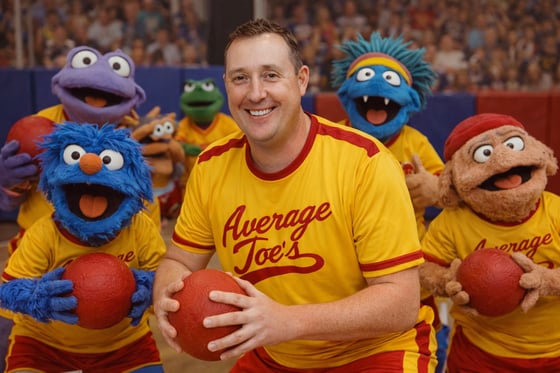

.png)
.png)