
Dr. Ryan Ries back again this week with the next edition of our “AI in Your Industry” series. This week: Manufacturing.
I'll be straight with you: manufacturing is the vertical where I have the least hands-on experience with AI.
But this industry was one of the most highly requested that I cover, so I would be remiss if I didn’t include it in the series.
What I’ve Worked On
Predictive Maintenance
At its core, predictive maintenance uses IoT sensors mounted on physical equipment to stream real-time data — temperature, vibration, pressure — into machine learning models that have been trained on historical failure events. The models learn what "normal" looks like for that specific machine, then flag deviations before they become failures.
Think of it less like a heart monitor and more like a cardiologist who has read ten thousand EKGs and calls you three days before the heart attack.
Predictive maintenance has been around for a bit, but manufacturing is now really leaning into predictive maintenance with AI.
At Mission, we built a predictive model for a large industrial manufacturer facing a classification problem with hundreds of distinct failure codes across thousands of equipment assets. Their challenge was forecasting which machines were likely to fail and why, before the failure occurred.
Same fundamental structure as any supervised learning problem: historical outcome data, labeled failure events, real business impact.
We used Amazon SageMaker and S3 to build a model that could flag likely failures upstream, giving maintenance teams a window to act before unplanned downtime hit the production schedule.
The potential cost avoidance ran into the millions annually.
Digital Twins + AI
A digital twin is a virtual replica of a physical asset (a machine, a production line, an entire facility).
By itself, a twin is just a very good simulation tool. Pair it with an AI agent that learns from that replica, and the combination becomes something much more interesting.
You can simulate process changes before making them in the real world, test failure scenarios without risking production, and catch inefficiencies in your virtual model before they become costly in your physical one.
The biggest value with this is the continuous learning loop between the virtual and physical system. The twin gets smarter as the physical asset generates more data. The physical asset gets better decisions as the twin's model matures.
We built an AI-powered digital twin for a multi-site manufacturing operation that was flying blind on operational data.
Their coordinators were managing scheduling, resource allocation, and throughput across dozens of facilities using largely manual processes with no visibility, no forecasting, and no early warning system.
We integrated their existing data infrastructure with a modern AWS architecture using Amazon Bedrock, LangChain, and near real-time dashboard visualization to create a living operational model of their facilities. Site managers gained the ability to forecast production scheduling loads, optimize floor-level resource allocation, and surface operational anomalies before they cascaded into downtime.
That is the digital twin value proposition in practice: not a simulation you run once to answer a question, but a continuously updated mirror of your physical operation that gets smarter every shift.
Use Cases I’m Watching
Autonomous Robotics
BMW and Fanuc are running autonomous robotics systems that independently detect bottlenecks, adjust workflows, and optimize material handling in production.
Fanuc is reporting roughly a 25% reduction in human intervention on certain production tasks.
The shift from "robot that executes instructions" to "robot that revises instructions based on what it observes" is a genuinely different category of capability and one that I see completely changing manufacturing.
Supply Chain Decision-Making
Siemens AG deployed agentic AI to manage supply chain decisions in real time.
AI agents respond to demand signals without queuing for human review. Inventory holding costs reportedly dropped nearly 20%. That number comes directly from removing latency in the decision loop — the time between a signal appearing and a decision being made.
Agents that can act on data (reliably) in seconds rather than hours are solving a different problem than traditional supply chain software ever could.
This actually takes me back to a project from an earlier chapter of my career that sits close to what Siemens is doing, just with far less fanfare and zero articles about it.
We were working with a plastics manufacturer that produced resins for injection molding companies. Their buying process was a mess of gut calls and spreadsheets. The core problem was to figure out what raw materials to buy, in what quantities, and when — given storage constraints, budget constraints, demand forecasts, and the predictable rhythm of seasonal customers who came back every year like clockwork.
The model had to hold all of that simultaneously. How much bulk volume could you commit to given available storage? What's the probability you burn through inventory before it ties up capital? Which seasonal accounts are likely to reorder in Q2, and can you pre-buy material now to cut their wait time and protect the margin?
We built a traditional ML model that ingested all of those constraints and predictions, then optimized across them to generate a recommended buying strategy.
Tying It All Together
Before I leave you this week, I want to say something that might not be the most popular take right now.
Agentic AI on the factory floor and self-optimizing digital twins are cool and exciting. I'm not dismissing them.
However, while everyone is chasing the next frontier, a lot of manufacturers are leaving serious money on the table by skipping the fundamentals.
Traditional machine learning isn't flashy. It doesn't make for a great conference keynote.
But the “boring” stuff works. It has been working for years. And in my experience, the organizations that try to leapfrog the fundamentals in pursuit of the more exciting technology almost always end up building on an unstable foundation.
If you want to think through where your operation sits on that spectrum or if you’re ready to build out one of these use cases, I'd love to chat. Reach out to our sales team here.
Until next time,
Ryan
Now, time for this week's AI-generated image and the prompt I used to create it.
Create an image of a muppet working in a factory. The muppet is running a production line of mini AI Agent Ryan bots. The muppet should be wearing a labcoat, safety glasses, and has a sinister expression on his face. For the AI agent ryan bots, please use my reference photo to understand how the Ryan bots should look.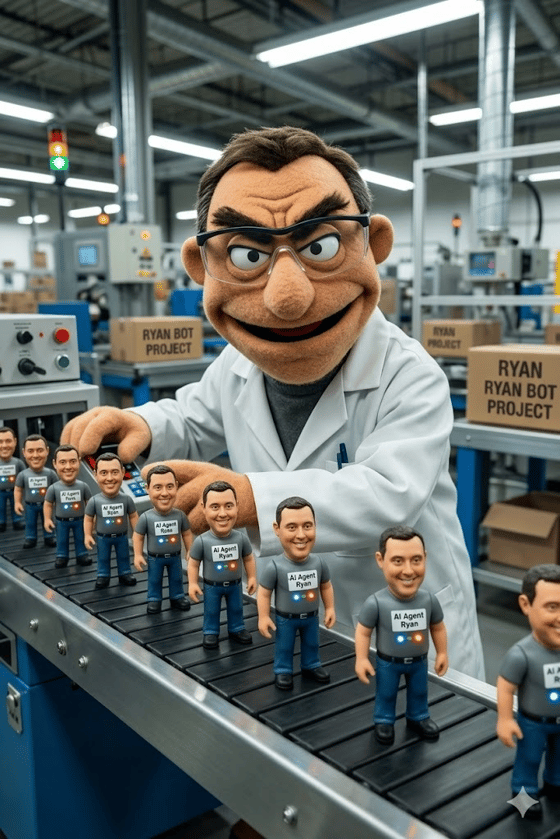

.png)
.png)