
Dr. Ryan Ries here. Every time I walk into a customer meeting or show up at an AWS event, someone asks the same question: "Ryan, what AI use cases are you actually seeing work in [insert any industry]?"
I've answered that question hundreds of times. So let's just make it a series.
Today I want to kick off “AI in My Industry” — each week, (for I’m not sure how many weeks yet) I'll pick one industry and walk you through the most interesting use cases for that industry. We’ll walk through what we've built at Mission, what I'm watching from the outside, and how this all ties together.
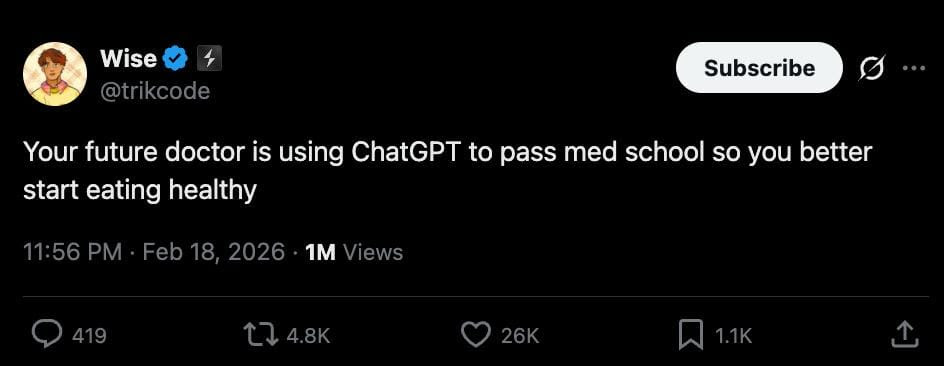
This week, I saw this in a newsletter and it made me laugh, so we’ll kick this series off with the healthcare industry.
Use Cases I’ve Personally Worked On
Virtual Patients That Actually Act Like Patients
BreakAway Games came to us with a genuinely interesting problem. They build training simulation games for medical students, nurses, and healthcare professionals. Their existing virtual patient system worked, but it was too clean. Too logical. Real patients don't present their symptoms like a textbook. They forget details, they misuse medical terms, and sometimes they just don't know what's wrong with them.
We built a proof of concept on Amazon Bedrock with AWS Lambda that simulates exactly that kind of imperfection. The AI had to be deliberately constrained, which is the opposite of what you normally optimize for, to reflect realistic patient behavior including limited health literacy and varied language fluency.
We created a scalable platform supporting roughly 24 virtual patient profiles for initial validation, accessible 24/7, without the cost and scheduling nightmare of hiring standardized patient actors. For nursing programs specifically, where we learned that attrition in the first year is devastatingly high, this kind of accessible practice tool is invaluable.
Modernizing Clinical Reasoning Training
Another company we worked with has been building medical education software since 1992, with the same codebase since 2000. They knew it was time to modernize and innovate.
We helped them build a new platform that replaces the old multiple-choice question interface with natural language AI conversations. Students interview virtual patients the way they'd interview a real one. The system is specifically designed to catch "zebra" cases, the rare conditions that hide behind common symptoms.
These two use cases alone tell us that the healthcare education space is ripe for innovation.
Transforming Payment Adjudication
Now for one of my favorite intelligent document processing (IDP) use cases.
Paynela, a healthcare financing company based in Puerto Rico, was drowning in manual claims processing. Reviewing a single claim took up to two business days. Their adjudication process ran six to eight minutes per claim. Everything stopped after business hours.
We integrated Amazon Textract for OCR-based document extraction and connected it to an LLM pipeline through Amazon Bedrock. Claims now process in under three minutes. Adjudication takes one minute or less and accuracy jumped from 90% to 99%. The system runs around the clock with minimal human intervention.
GL Code Automation in Healthcare Procurement
Procurement Partners, an existing Mission MSP customer, was dealing with a tedious manual process: assigning and managing general ledger codes. Time-consuming for their team, frustrating for customers and vendors alike.
We built a solution using AWS Bedrock to streamline how those codes get managed, reducing the burden on both customers and vendors.
It's a narrow use case but it's also exactly the kind of unglamorous, high-volume workflow where AI pays for itself fast.
Use Cases I'm Watching
Post-Visit Gap
A cardiologist just placed 3rd in Anthropic's global hackathon by building postvisit.ai — an AI companion that helps patients figure out what to do after a doctor's appointment.
Patients are confused after visits. Instructions get lost, follow-up questions go unanswered until the next appointment. You end up Googling your questions, only to find conflicting information.
A well-designed AI companion sitting between the visit and the follow-up care fills a real gap.
We actually pitched a nearly identical concept to a customer not long ago. Watching a cardiologist build it over a weekend and get 3.4 million people to pay attention is a reminder that the best AI solutions in healthcare aren't always the most complex ones. They're the ones that sit right at the friction point between patient and care.
Patient 360
One of the biggest structural failures in healthcare is that your doctor often doesn't have the full picture. Your cardiologist doesn't know what your neurologist prescribed. Your urgent care visit last month never made it into your primary care chart. HIPAA was a necessary step for patient privacy, but it also created walls that fragment care in ways that hurt patients every day.
How many times have you experienced challenges with the healthcare system because of this?
AI is starting to break those walls down. Not by bypassing privacy protections, but by intelligently synthesizing the data that is available into a coherent patient view. When a care team can see the full story — medications, history, test results, monitoring data — they make better decisions. This is the idea behind a Patient 360 view, and it's one I think about constantly when we're designing healthcare AI solutions.
AI in Imaging and Early Detection
This is one of the areas I find most compelling right now. Machine learning and deep learning models can process medical images, test results, and patient records at a scale and speed no human practitioner can match. More importantly, they can surface patterns and anomalies that are invisible to the naked eye — often before a patient shows any symptoms at all.
Early detection changes outcomes. In oncology, in cardiology, in neurology — catching something at stage one versus stage three is the difference between a manageable condition and a devastating one. We're just scratching the surface of what's possible here.
Personalized Medicine
One more for good measure!
Right now, treatment is largely population-based. You get the drug that works for most people with your condition. But most people aren't you.
AI can analyze patient records, genetics, and real-time health monitoring data to predict how a specific individual will respond to a specific treatment. That's the idea behind personalized medicine and it's an emerging field that's starting to deliver real results. Genetic medicine is the frontier here. When we can tailor therapies at the genetic level, we stop treating the average patient and start treating the actual person in front of us. I think this shift will be one of the most significant things AI does for humanity.
What Ties All of This Together
The healthcare use cases that actually work share a few traits. They target specific, repetitive, high-cost pain points, they keep humans in the loop, and they use AI to extend access to training, remove barriers to financial assistance, improve patient outcomes, and provide post-visit guidance.
If you’re curious about any of these use cases or have a cool one you’ve seen recently, reply and let me know!
Also, if you’re interested in building out a use case for your healthcare business, reply directly to this email or reach out to our sales team here.
Until next time,
Ryan
Now, time for this week's AI-generated image and the prompt I used to create it.
Create a hyper-realistic 1080x1080 square render of me (reference pic attached) gently holding a rounded, beveled miniature display platform showcasing a 3D collectible diorama of Denver, Colorado. Feature its most iconic landmark, small-scale modern and historical architecture, and lush miniature greenery and trees. A bold 3D "DENVER" sign is cleanly built into the front edge of the platform. Use a refined, saturated color scheme. Light the scene with soft studio illumination, warm highlights, and subtle depth shadows. Place the composition against a neutral gray gradient backdrop, keeping the same viewing angle and perspective for consistency. Add atmospheric depth, photorealistic textures, and ultra-precise detailing for an 8K quality high-end collectible aesthetic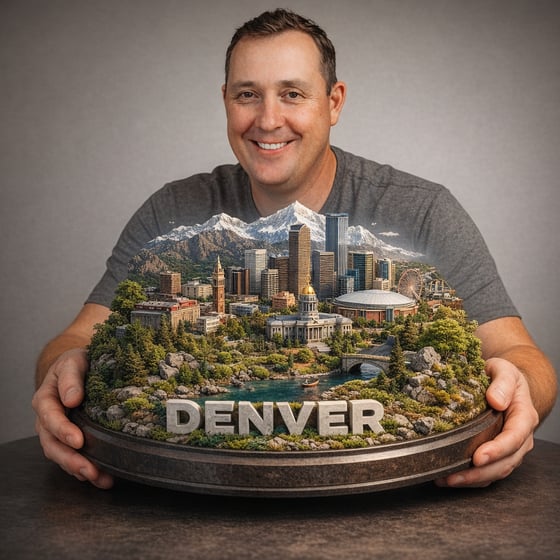

.png)