
Dr. Ryan Ries here. This week, I read about some pretty crazy (kind of scary) announcements that came out of CES. I’ll be covering those plus a couple of other things this week.
The Longevity Mirror
NuraLogix launched something they're calling the "Longevity Mirror" at CES. At $900, it scans your face for 30 seconds each morning, analyzes blood flow patterns using AI trained on hundreds of thousands of patient records, and spits out a "Longevity Index" that predicts your cardiovascular risk, metabolic health, mental stress, and biological age up to 20 years out.
Not to be the Debbie Downer, but…

Instead of going to the doctor and just being disappointed by the scale, we now have AI that tells you how fast you're dying.
While this is certainly helpful data, it feels like a big bundle of anxiety to me…
Should Quantification Replace Intuition?
I've spent two decades building AI systems for healthcare, and at Mission, healthcare is an industry we specialize in. I understand the value of predictive analytics. I've seen models save lives by catching patterns humans miss.
But there's a massive difference between a diagnostic tool used by trained clinicians in appropriate clinical contexts and a mirror that turns into the scarier sibling of the Snow White Magic Mirror.
The problem isn't the technology itself. Transdermal optical imaging is legitimate. The issue I see is what happens when you take such powerful predictive modeling and drop it into someone's life without the context, expertise, or support systems.
Maybe that support is built in, and I just missed it on their website, though.
Sharp's Poketomo: Memory as a Service
While we're talking about technology that makes me uncomfortable, Sharp introduced "Poketomo" at CES. It's a small, meerkat-shaped AI companion with a camera that automatically records your daily interactions and conversations. Through an app, you can search and replay past experiences based on people, events, or conversations.
They're positioning this as a "memory aid."
The complete outsourcing of human memory to an external system that never forgets, always records, and makes your past permanently searchable eerily reminded me of the Black Mirror episode S1E3 called “The Entire History of You”.
There's a reason our brains forget things. Forgetting allows us to move past difficult experiences, to let go of grudges, to grow beyond who we were. When every conversation is permanently archived and searchable, we lose the ability to leave things behind.
Research on human memory shows that the act of remembering, reconstructing events imperfectly, is central to how we process experience and build identity. When we outsource memory to systems that record everything perfectly, we change our relationship with our own past.
Here are my questions about Poketomo that I’m still looking for answers on:
- Who owns that archive?
- What happens when your AI companion has recorded years of private conversations, intimate moments, and personal interactions? Where does that data live? Who can access it?
- What happens in a divorce or a legal dispute?
Boston Dynamics and the Robot Problem
While we're discussing CES, I want to mention something that got less attention but probably deserves more: Boston Dynamics' Atlas robot started its first real factory work at a Hyundai plant in Georgia. It's autonomously sorting parts without human intervention.
LG launched CLOiD, a home robot powered by NVIDIA's Jetson Thor platform that can roam your house, understand context, and control smart devices.
And NVIDIA partnered with Eli Lilly to launch a $1 billion AI drug discovery lab combining Lilly's biological data with NVIDIA's computing power.
When Atlas is sorting parts in a factory, that's automation doing what automation has always done: replacing repetitive human labor with machines. But when it's a humanoid robot that moves like we do, navigates spaces designed for humans, and operates autonomously, it’s different. The line between "tool" and "agent" gets blurry.
When a robot lives in your home, controls your devices, and "understands context," we need to ask: what does it understand? What is it learning about your patterns, your habits, your vulnerabilities? Where does that data go?
My Ask
If you're building AI systems, especially ones that touch health, memory, or intimate aspects of people's lives: slow down.
Ask harder questions.
Bring in ethicists, clinicians, privacy experts, and the people who will actually use these systems before you launch, not after.
Build privacy and safety into the architecture, not as features you add later.
As a shameless plug, bring in a partner like Mission, who has done hundreds of these implementations on AWS.
And if you can't answer basic questions about data governance, clinical validity, or what happens when things go wrong, you're not ready to ship.
If you're using these new systems as a consumer or business, be skeptical.
Ask what data you're giving up, who has access to it, and what happens to it when the company gets acquired or goes bankrupt. Read the privacy policy. Understand the limitations. And remember that just because something produces a number doesn't mean that number is meaningful or that you should organize your life around it.
I love AI. I've spent my career building it. But the best way to destroy trust in this technology is to ship products that prioritize engagement over safety, data collection over privacy, and novelty over actual human benefit.
Ryan
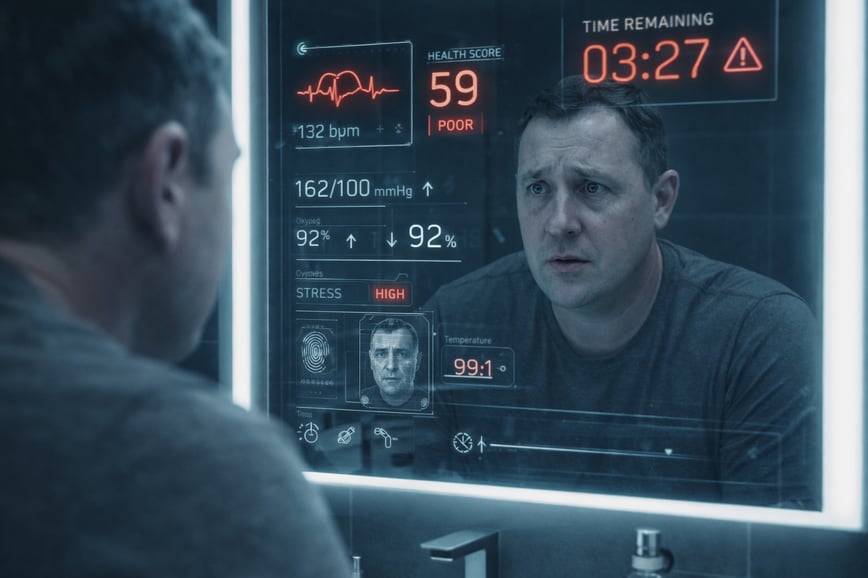
Now time for this week’s AI-generated image and the prompt I used to create it. It only gave me 3 minutes left to live?!
Create an image of a bathroom mirror that displays a person's reflection, but overlaid on the glass is a digital interface showing biometric data, health scores, and a countdown timer. The person looking into the mirror should appear concerned or anxious. Make the person in the mirror look like me, I've added a reference photo. The aesthetic should be sleek and modern, but with an unsettling, clinical feel to it.

.png)
.png)