Last week, I had dinner with a group of CTOs, and the conversation eventually landed where these conversations always seem to land lately: AI is letting us do more, faster, with fewer people in the loop.
That part is not particularly surprising anymore.
But then the next question was:
Now that we can do so much more, do we actually want to?
Because customers are already dealing with feature fatigue. Add too many options, too many screens, too many workflows and too many “helpful” AI capabilities, and the product gets harder to understand. Eventually the customer stops using it, not because it cannot do enough, but because it does too much.
We have spent years asking whether AI can build things. I think the more important question is becoming whether those things deserve to exist.
Before I jump in, I want to quickly plug Mission Cloud’s re:Invent activities – there’s a lot of good stuff we’re involved with this year!
- We’ll be in the expo hall at booth #1656. Come get some cool swag and chat with our team about your AI roadmap.
- I will be hosting a lightning session on Tokenomics on 12/1 in the partner advantage zone in the expo hall at 12:30 PM PT. Stop by and let’s chat afterwards.
- Also on 12/1, we’re partnered with AWS, Datadog, Nutanix, nClouds, DoIT, and Cloudera to co-host a women in tech leadership luncheon.
- Asim Iqbal, Field CTO on our team, is also hosting a lightning session on Wednesday, 12/2 at 12 PM PT in the partner advantage zone. He’ll be talking all about how to NOT create agents of chaos.
- If you’re interested in seeing how Amazon Quick can transform your enterprise, meet me at AWS's customer event on 12/2 at Treasure Island from 12-3:45 PM PT.
- And last but certainly not least, one of the most anticipated events of re:Invent every year: Mission Cloud IGNITE, this year with a special guest performance from Nelly! Make sure you register ASAP, this event is our biggest every year.
The AI Factory Is About to Get Much Faster
This past week and a half in tech was obviously... crazy.
But I want to focus on only two stories that caught my attention this week. Together they point toward the same future.
First, Anthropic disclosed that future Claude models may dramatically accelerate AI research. Claude already helps run experiments, generate training data, write code, and evaluate new models. Anthropic is not saying recursive self-improvement has arrived, but it is telling investors that AI-assisted AI development could create speedups the company may not immediately recognize.
Then DeepSeek proposed its Super-agent architecture for coordinating large numbers of AI tasks without a human babysitting every session. A Router assigns work, Workers execute in parallel, and a Watchdog checks whether the agents are stuck or wandering off.
I guess we're automating middle management now?
DeepSeek says people can keep track of only three to five agent sessions at once. In its simulated scheduling tests, 95th-percentile completion time fell from 29.5 minutes to 15.7 minutes. That’s nearly twice as fast, although it consumed more tokens and did not measure whether the resulting code was actually good.
The open-source DeepSeek Harness prototype is still research code, not a production-ready system. But the direction is hard to miss.
AI is beginning to manage AI.

Whether recursive self-improvement arrives next year or much later, every person and every team is about to have more production capacity than they know what to do with.
The Bottleneck Is Moving From Execution to Judgment
Historically, engineering capacity acted as a filter. We could not pursue every idea because we did not have enough time, people or budget.
Not having the resources was frustrating, but it also forced prioritization.
Agents weaken that filter.
If ten agents can build ten features before lunch, somebody still has to explain why any of those features should ship.
That is the part I think organizations are underestimating. When implementation becomes cheaper, every idea starts looking affordable. Roadmaps get crowded, features overlap, and then support and training costs grow. The security and maintenance surface expands. And customers have to navigate the accumulation of every locally reasonable decision we made along the way.
Feature Fatigue Is an Old Problem AI Could Supercharge
Feature fatigue existed long before generative AI. Customers often say they want more capability when comparing products, then prefer simplicity once they actually have to use the thing.
AI makes it easier to satisfy every individual feature request. But a collection of locally reasonable additions can create a globally incoherent product.
“The customer requested it” does not mean every customer should see it. A feature that helps one workflow may add friction to twenty others.
AI personalization may eventually hide some of this complexity by exposing capabilities only when the context or role requires them. But personalization cannot rescue a product that has lost its center.AI can remove the cost of adding a button, but it cannot remove the cognitive cost of making the customer understand the button.
A Few Things I Would Do Now
- Add a complexity budget. Treat customer attention and interface complexity as finite resources, just like engineering capacity.
- Require an outcome, not merely a request. Every proposed feature should name the user behavior or business result it is expected to change.
- Prototype with people doing real work. Asking whether someone wants a feature is different from observing whether it improves the task.
- Make removal part of the roadmap. Track unused, duplicative and high-support features, then create an intentional retirement process.
- Use progressive disclosure. Show advanced capabilities when the context or role requires them instead of placing every option in front of every user.
- Set stop conditions for agents. Define task size, acceptance criteria, escalation rules, cost limits and the conditions under which the agent should stop.
- Expand AI-DLC acceptance criteria. Do not ask only whether the generated software works. Ask whether the change should exist, whether people can understand it, and whether the organization can safely reverse it.
Some Final Thoughts
AI is changing the economics of creation.
However, it's not changing the economics of customer attention.
Customers still have the same number of hours, the same cognitive limits, and the same tolerance for an interface that makes them think too hard. Building more is not the same as creating more value.
The durable advantage will come from combining AI speed with product restraint, user understanding, validation, and a willingness to subtract.
The next generation of great AI products may not be the ones with the most features or the most agents. They may be the ones that use all that intelligence to make the experience feel simpler.
That takes judgment and the confidence to say no. And it takes a delivery process that verifies not only that something can be built, but that it should be built.
If your AI roadmap is growing faster than your ability to prioritize it, or if you are exploring how AI-DLC can bring stronger acceptance criteria and governance to agent-generated work, reach out to us.
Until next time,
Ryan
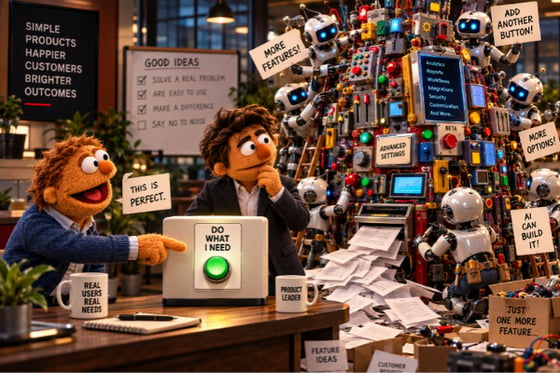
Now time for this week’s AI-generated image and the prompt I used to create it.
Create a playful cinematic editorial scene for an enterprise AI newsletter. A fuzzy puppet product leader stands beside a simple control panel with one useful button. Behind the product leader, an army of enthusiastic robot engineers tries to attach hundreds of unnecessary buttons, screens, switches and levers. A fuzzy customer points to the one button actually needed. The contrast should communicate feature fatigue and product restraint: simple customer need versus runaway AI production capacity. Polished, humorous and executive-appropriate, with warm studio lighting and a red, charcoal, cream, teal and gold palette.