
Dr. Ryan Ries here. Last week I was reminded of a lesson that every organization pursuing AI eventually learns:
The quality of your AI outcomes will never exceed the quality of your data.
Story time: When your data embarrasses you
I was in Utah leading a customer workshop on AI strategy and roadmapping. The session focused on helping organizations think beyond the hype around AI and identify practical, high-value AI use cases. We discussed where our customers are seeing measurable ROI, how to prioritize opportunities, how to score use cases, and how to build a roadmap that aligns AI investments with real business priorities.
To make the session interactive, we used a roadmapping application that I built using an AI-driven Development Lifecycle (AI-DLC) process. The application allows customers to log in, select their business priorities, evaluate use cases, and collaboratively build an AI adoption roadmap tailored to their organization.
The presentation went well. The discussions were engaging and customers were excited, which is always awesome to see.
Then reality hit.
As customers began logging in, several started raising their hands.
"My name isn't on the list."
Then another.
Annnnnd another.
At first, I assumed there was an issue with a specific account. It didn't take long to realize something larger was wrong.
The customer roster loaded into the application was incomplete. The application itself was working fine. The problem was just with the data.
Prior to the event, I had been given a spreadsheet containing attendee information. While preparing for the workshop, I found what I believed was the latest version of the customer list in a Slack channel. I assumed it represented the complete attendee roster and loaded those names into the system.
What I later discovered was that the spreadsheet represented only a subset of attendees from one sales director's team. The actual master customer list had been shared earlier.
I had the data but, like a bad data scientist, I didn’t validate it.
And that's the difference between having data and having governed data.
What Is Data Governance?
When people hear "data governance," they often think about compliance policies, security controls, or lengthy committee meetings. In reality, data governance is much simpler.
Data governance is ensuring that the right people are using trusted, accurate, and validated data.
It means understanding:
- Where data comes from
- Who owns it
- Whether it is complete
- Whether it is current
- Whether it is authoritative
In my case, I failed to verify whether the spreadsheet I had was the authoritative source. I trusted the data because it existed. I should have trusted the process. A quick validation with the event organizer would have immediately revealed the gap.
What Is Data Validation?
Data validation is the practical step that ensures data is fit for use before it enters a process, application, dashboard, or AI model.
It's asking questions like:
- Is this the complete list?
- Are there missing records?
- Has someone confirmed its accuracy?
- Is this the latest version?
- Does this data match reality?
Organizations often focus on sophisticated AI models while skipping these basic validation steps. The result is predictable. They build impressive systems that produce inaccurate outcomes because the underlying data was never verified.
Where AI Makes This More Important
AI increases the need for governance.
As organizations begin implementing copilots, agents, knowledge assistants, and intelligent workflows, the consequences of poor data become more visible and more expensive.
An incorrect spreadsheet becomes an inaccurate dashboard.
An inaccurate dashboard becomes a poor recommendation.
A poor recommendation becomes a bad business decision. You get the point!
AI can accelerate insight, but it can also accelerate mistakes.
That's why data governance is not an AI problem, but it’s actually a business discipline that becomes increasingly important in the age of AI.
The Other Side of the Story: Why AI-DLC Matters
Fortunately, this story has a happy ending.
One of the principles we used while building the application from my original story was an AI-driven Development Lifecycle (AI-DLC) approach that emphasizes rapid iteration, brainstorming, requirements definition, and continuous refinement.
Early in the design process, we identified a simple but important requirement:
Administrators should be able to quickly add customers without requiring code changes or developer intervention.
At the time, it felt like a convenience feature just for the marketing folks.
During the event, it became a business continuity feature.
As customers identified that they were missing from the system, I opened my laptop, added them to the environment, and within minutes they were able to access their roadmaps and continue the workshop without disruption.
The underlying data issue still existed.
But because the application had been designed for adaptability, we were able to resolve the problem in real time. That's one of the biggest lessons I've learned from AI-DLC.
The goal isn't to build software that assumes everything will go perfectly (in my wildest dreams). The goal is to build software that can gracefully handle when reality proves your assumptions wrong.
Final Thoughts
The biggest lesson from this experience wasn't about AI or software. It wasn't even about roadmapping!
It was about something much more fundamental:
Bad data can create bad experiences faster than almost any technology can fix them.
At the same time, thoughtful design can dramatically reduce the impact when those issues inevitably occur.
Data governance ensures you're building on a solid foundation and that you're starting with the correct inputs.
And an AI-driven development approach helps create systems that can adapt when the unexpected happens.
This week, I got a firsthand reminder that AI success starts long before the model, the prompt, or the application.
It starts with the data.
How's your AI strategy going? Mission Cloud's AI Roadmapping helps you figure out where agents create real value, where they need tighter boundaries, and how to get from pilot to production without surprises. If you’re interested in having a discussion about your AI roadmap or your software/AI DLC, let us know!
Until next time,
Ryan
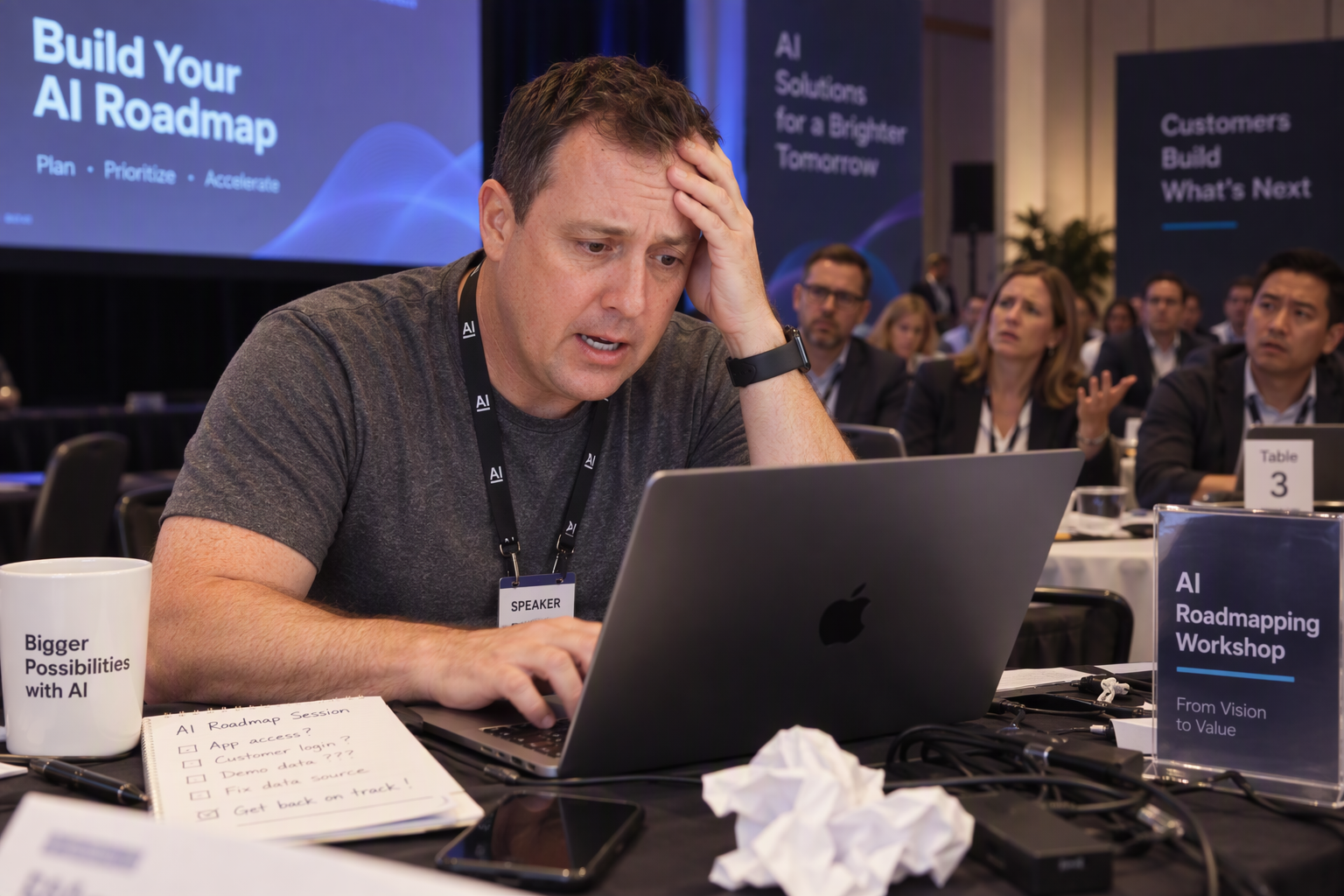
Now, time for this week’s AI-generated image and the prompt I used to create it.
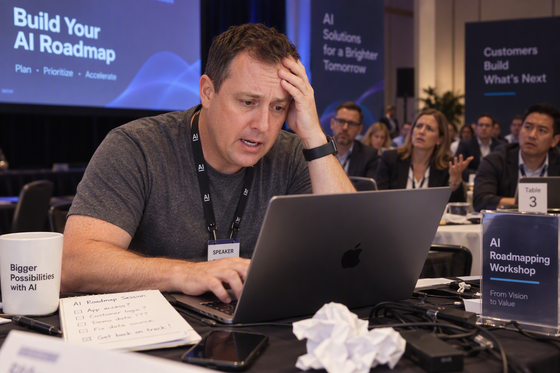
Create an image of me at a live conference where I am leading an AI roadmapping session. I am scrambling because my data is incorrect and customers in the room aren't getting access to our roadmpaping app like I had planned for the session. I am stressed and typing rapidly on my computer to solve the problem. Reference my attached photo to use my likeness.


.png)