
Dr. Ryan Ries here. This week I want to dive into a question that I’m getting asked almost every week.
“Should we move our AI workloads to Amazon Bedrock?”
The answer is not as simple as you might think. And although yes, Mission Cloud is the dedicated AWS practice within CDW, and we are 100% AWS-focused, I am going to give you my honest thoughts on this.
Why Teams Are Looking at This Move
The interest in Bedrock makes sense. Running generative AI in production, whatever model sits behind it, eventually runs into the same wall: a model endpoint alone was never built for enterprise governance. Bedrock answers that with IAM-based access control, VPC endpoint isolation, Guardrails, and unified monitoring through CloudWatch. One security model, one logging pipeline, one place to watch cost and usage across every model you run.
The economics behind Bedrock matter too. Committed AWS spend, Enterprise Discount Program or Private Pricing Agreement, gets consumed by Bedrock usage at full value, the same treatment AWS gives its own first-party services. Add prompt caching, which can cut costs up to ninety percent on repeated system prompts for supported models, and tiered routing that sends simple requests to smaller, cheaper models while reserving the expensive ones for complex reasoning, and the cost case is very compelling for teams running high volume.
None of that is just marketing. Teams running production workloads on OpenAI, Gemini, or a direct model API are finding real savings and real governance improvements when they make the move. The question isn't whether Bedrock is capable. It clearly is. The question is whether your specific workload needs what it offers today.
When the Answer Is Yes, Without Much Debate
Despite my comment earlier, there are some times when a Bedrock migration is a no-brainer.
Compliance certifications attach to infrastructure, not to a model sitting off on its own.
By using OpenAI or Anthropic directly, your data leaves whatever environment your company already built and certified. That vendor now sits inside your compliance boundary whether you meant to put them there or not, and you've just inherited a new relationship to contract, audit, and re-approve every year.
Most regulated enterprises already run their core systems on AWS, and they've already done the hard, slow work of getting that environment authorized: FedRAMP for a federal contract, a signed BAA for healthcare data, SOC 2 for a financial services customer.
That process took months, and it covers everything already living inside the account.
This is the big payoff of Bedrock. It runs inside that same already authorized AWS environment. Your AI workload doesn't add a new vendor to the compliance boundary. It becomes another service living inside a boundary that's already been audited and signed off on.
That's why a healthcare workload with a data residency requirement, a federal team needing FedRAMP coverage, or a financial services group with a compliance policy already on the books all land in the same place. It's not that Bedrock beat the alternatives on some scorecard. It's that keeping the workload inside a boundary you've already paid to get authorized beats extending that boundary to a brand new vendor. Once that's the real requirement, the conversation stops being "should we migrate" and becomes "how do we migrate well."
If nothing legally or contractually requires your data to stay inside a specific boundary, none of this applies to you. You're not exempt from a decision, you're just facing a real one. The next section walks through exactly what to weigh in that case: the features that don't move cleanly, the commercial reset, the actual work a migration takes. That's the honest version of this decision, and it's the one most companies are actually making.
When You Actually Have to Weigh It
Here's where I throw up a yellow flag and ask people to sloooowwww down.
Not every provider maps cleanly onto Bedrock, and not every feature you rely on today has a direct equivalent yet. Depending on what you're moving from, things like persistent conversation threads, certain real-time voice capabilities, or specific image generation features may need a workaround or a partial migration rather than a clean lift and shift. AWS has gotten better at surfacing these gaps early through its own assessment tooling, a very welcome change!
There's a commercial layer too, separate from the technical one. Existing pricing agreements with your current provider don't carry over automatically. A new agreement needs to be in place before usage starts on the new path, since pricing isn't retroactive. And moving means a fresh administrative start: accounts, access policies, and historical data don't carry over on their own. All solvable, but definitely none of it something to discover mid migration.
I like to tell people to think of it like relocating a business to a new building. The new building might have better security, lower rent, and a nicer lobby. None of that matters if you show up moving day and realize half your equipment doesn't fit through the door. A walkthrough first tells you exactly what needs a moving plan and what needs to be replaced.
My Thoughts
Bedrock is a strong, well-built platform, and for the right workload it's an easy yes. My only real caution this week is against treating "AWS is the better platform for this" as the same question as "does my workload need this right now?"
Most organizations I work with land somewhere in the middle: some workloads move to Bedrock because a real compliance boundary makes it the obvious answer, others stay put because there's no requirement forcing the move and the current setup already works fine.
If you're weighing this decision for your own workloads, a fully funded AI Roadmapping session with our team is the right place to start. We'll walk through what you're running today, what your goals are for the future, what funding is available, and more. If you’re interested in that type of session, reach out to our team here.
Until next time,
Ryan
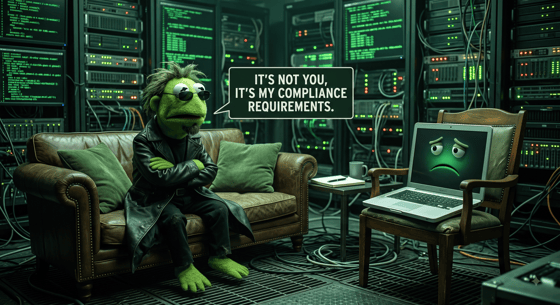
Now, time for this week’s AI-generated image and the prompt I used to create it.
A muppet in the matrix on a therapist's couch inside a glowing green server room, arms crossed, saying (via a speech bubble) "it's not you, it's my compliance requirements" to a sad looking laptop sitting in the chair across from him.

.png)
.png)