Dr. Ryan Ries here. I’ve got some good stories for you this week! Five different stories crossed my desk this week, and none of them are about the same thing.
Before I begin, I have a couple of upcoming events you should know about.
- For our NYC-based friends: AMD & Mission are teaming up on 8/13 to bring you an event on running agentic AI efficiently. Register here – spots are almost gone.
- For our healthcare friends: Our first healthcare-focused AI strategy workshop filled up FAST. We’re running another one on 9/1 – sign up here.
- For our financial services friends: We’re running an industry-focused AI strategy workshop for finserv leaders. Register here.
- For all our friends: In this interactive webinar on 8/20, I’ll show you how to uncover AI opportunities, score them, prioritize them, AND put them into practice. Register here.
Alright, now let’s look at these 5 stories.
Intelligence Is Turning Into a Utility Bill
Here's a sentence that would have sounded absurd two years ago: most companies no longer need a frontier model to draft an email or build a slide deck. Zack Kass, who used to run go-to-market at OpenAI, has a name for this. He calls it diminishing model returns.
Coinbase CEO Brian Armstrong said in June that his company held AI spend flat while usage climbed. The trick wasn't some secret discount. It was just routing.
Simple tasks go to cheaper models, GLM 5.2 and Kimi 2.7 among them, and only the hard problems get sent up to the expensive tier. Microsoft appears to be circling the same idea, reportedly weighing DeepSeek V4 as a lower cost option inside Copilot Cowork.
A quick note on tokenomics while we're here. The memory shortage rattling the industry right now (more on that below) is pushing more customers toward AMD's chips, and for good reason. AMD delivers strong price to performance and a smaller power draw per workload, which matters twice: once on your cloud bill, once on your carbon footprint.
None of this kills the frontier lab business model. It just means the premium only holds if performance stays out of reach for the cheaper models. Labs are shipping new releases fast enough that this balance could flip in a single week.
At this stage in the game, routing is the difference between a cost center and a controlled one.
The End of Waiting for the Specialist
OpenAI dug through more than 800,000 work messages from U.S. ChatGPT users and found something interesting. Among messages tied to a specific occupation, 43.5% involved a task that traditionally belonged to a different job. Strip that down to all work messages, generic or not, and the number settles at 16.8%. Both figures are accurate. They're just answering different questions.
What does this mean? Breaking it down by job function helped me understand this further:
Customer experience workers showed the highest crossover rate at 77%, with design close behind at 75%, HR at 69%, legal at 56%, and marketing at 53%. Small teams lean into this hardest, since a company with five seats can't staff a dedicated specialist for every function that pops up.
I want to head off a misreading here. This isn't job displacement dressed up in research language. Nobody's claiming a salesperson has quietly become a data scientist. Working cross-functionally has always been a thing.
What this data tells us is actually pretty cool. A worker who hits a wall can now draft, calculate, or diagnose a first pass without sitting in a queue for another department to get to it. Roles aren’t disappearing because of this. It’s actually making everyone’s workloads a bit lighter.
If you lead a team, this is your cue to look at where internal bottlenecks actually sit. Chances are your people are already routing around them with a chat window, whether you've sanctioned it or not.
Digital Twins of Everyone Alive???
Simile, a Palo Alto startup out of Stanford, just closed a $200 million Series B at a $2 billion valuation. Five months earlier, its Series A landed at $100 million. That's a HUGE jump in valuation in under half a year, and it tells you something about how badly enterprises want a shortcut around focus groups.
Founder Joon Sung Park built his reputation on a 2023 research project called Smallville, where 25 AI agents lived out simulated daily routines inside a virtual town, complete with parties nobody scripted. (I wish I would’ve thought to make playing the Sims my job!)
That research became the seed for a company whose public goal is modeling how all eight billion people on the planet would react to a decision before anyone spends real money finding out. CVS Health is among its enterprise backers and users. A rival called Aaru raised its own round at roughly a $1 billion valuation, so this isn't a lone bet.
Here are my thoughts.
Simulating consumer behavior at scale is a useful tool for stress testing a pricing change or a benefit redesign before you commit budget to it. I could also see this also being used in crisis and disaster planning situations. You can’t deny this technology doesn’t have some incredible use cases.
Simultaneously, claiming you can model eight billion individual humans with fidelity is wild and I am skeptic about that.
A Company Wants to Put Your Mind in a Robot After You Die
Veterans First for America unveiled something called Digital DNA.
You, a human, would strap on a suit with 40 sensors. The suit would capture your movements, your vitals, your skills, and port the resulting profile into a humanoid body or a holographic projection once you're gone. Licensing runs from $300,000 for a century of use up to $1,000,000 for five hundred years, structured so a family trust or a company can manage it long after you're not around to argue about the terms.
I'll say plainly what I think about this: extraordinary claims need extraordinary evidence, and right now there isn't independent verification behind any of it. That doesn't make the idea worthless as a thought experiment. Posthumous digital continuity touches real questions about consent, data ownership, and what a company can do with a deceased person's likeness for five centuries of licensing revenue.
And would I want my mind used without my actual consent for centuries? Count me out!
Big Tech's Earnings and the Memory Squeeze
Amazon and Alphabet, two of the most profitable companies to ever exist, both posted negative free cash flow last quarter, betting hundreds of billions on AI infrastructure that won't pay off for years. Meta wasn't far behind, with cash flow dropping 91%.
Investors don't seem worried. The Nasdaq climbed roughly 2.5% on the week, reversing a slide that had been building since June, and Microsoft alone added a single day record of $450 billion in market cap.
Why, you may ask?
Infrastructure built now becomes the moat competitors can't easily copy later.
Underneath all of this is the story of memory. Industry insiders have taken to calling the current shortage RAMageddon. Consumers are already feeling it in the price of a new Mac or iPad, and analysts expect more increases before this eases.
This is exactly why chip selection is so important, and why Mission and AMD are hitting the road over to talk about it across the country between August and September. Teams running workloads on AMD hardware are seeing meaningfully better cost per compute cycle right now, on top of a lighter environmental footprint.
Some Final Thoughts
Looking at the stories above, you'll notice they don't agree with each other on much. One says intelligence is getting cheap. Another says physical memory chips are getting brutally expensive. One startup wants to predict your customers before they exist. Another wants to preserve you after you don't.
That’s our world now. It can be hard to figure out which of these trends actually matters for your organization. If you’re interested in doing a deep dive with our team for your organization, reach out to our team here.
Until next time,
Ryan
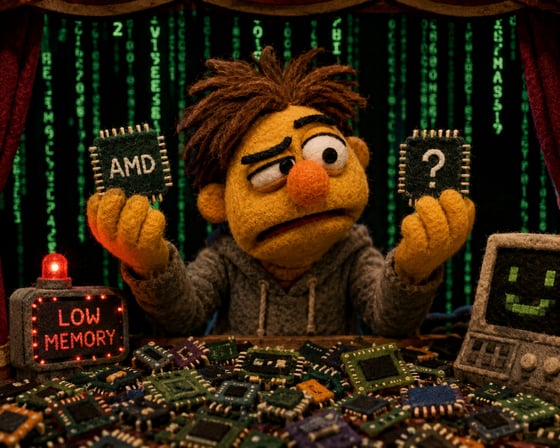
Now, time for this week’s AI-generated image and the prompt I used to create it.
A Muppet-style felt character surrounded by tiny felt computer chips and a small blinking "LOW MEMORY" warning sign, green Matrix-style digital code raining down in the background, the puppet holding up two felt chips in each hand like a scale, one labeled "AMD" and one labeled "?," confused and squinting expression, warm stage lighting, puppet theater aesthetic, whimsical and low-fi.

.png)