
Dr. Ryan Ries here.
It’s no surprise that this industry continues to move faster than any of us can truly keep up with. However, three stories caught my eye this week that I think you need to know about.
Before I jump in, here are some upcoming events I’ll be at that I wanted to share. Make sure you register asap to join me there!
- TODAY - June 10th: LA Happy Hour at Katsuya
- THIS FRIDAY - June 12th: Jonathan LaCour & I are cohosting another Agentic AI unscripted. We’ve gotten some great questions so far:
- Are companies starting to use model routers to cheaper models for certain tasks (e.g. cheap Chinese open source for coding, frontier closed U.S. for orchestration, etc.)?
- What is the prevalence of tokenmaxxing in reality?
- What is the true prevalence of all agent harnesses in enterprises and the open source vs. closed source mix?
- NEXT WEEK - June 17th: AWS Summit NYC Happy Hour at Le Jardin Sur Madison
AI’s Water Bill & Environmental Concerns
On June 3, the United Nations University put a number on something the industry likes to shove under the rug.
By 2030, the data centers running AI could pull 945 terawatt hours of electricity a year. That sits near triple the combined power use of Pakistan, Bangladesh, and Nigeria, three countries with more than 650 million people between them.
The water side is mind blowing too. Cooling all that silicon could swallow roughly 9.3 trillion liters a year, close to the basic household water needs of 1.3 billion people across Sub-Saharan Africa.
One detail in the report deserves a flag. The big energy drain is not training the models. It is inference, the everyday business of answering your prompts. Once a model ships, the daily flood of requests eats most of its lifetime power. Every query you fire off carries a cost, even the lazy ones.
That same week, Microsoft's CEO offered a softer picture. He said the company's newest closed loop data centers sip about as much water in a year as a single restaurant.
Maybe. I would want to read the meter before I printed that on a poster.
Meanwhile, AWS rolled out a new routing design called Resilient Network Graphs. It pushes 33 percent more traffic through 69 percent fewer routers, with a projected 40 percent cut in the electricity those networks burn. It has been the default for most new AWS data centers since April.
I told NetworkWorld why I buy it:
"Across the industry, there is growing pushback on data center expansion, tied to energy demand, water use, and local community impact, so power and water performance have become two of the most important issues facing cloud providers today. The efficiency claims are credible because AWS is saying RNG is already in production, and it's now the default architecture for most new builds globally."
Claims you can audit beat claims you cannot.
Claude Is Writing Claude??
Anthropic published a report this month with a figure that gave me visions of the Terminator.
More than 80 percent of the code merged into Claude's own codebase last month was written by Claude. A year and change ago, that number sat in the low single digits. The company says its typical engineer now ships about eight times more code per quarter than the 2021 to 2025 baseline. On the gnarliest, least defined coding tasks, it claims Claude got there 76% of the time in May, a 50 point jump in six months!
At this same time, Anthropic also warned about recursive self-improvement, the point where a model starts designing its own successor with little human steering, and they argue the industry should keep a pause button within reach.
I will hold two thoughts at once here.
I see the capability curve of these models every day. Also, every figure in that report is self-reported, unaudited, and landed days after Anthropic filed to go public. A company that warns about the danger of its own product, right as it courts public investors, is telling a story with more than one motive. Take the trend seriously but also, let’s not panic yet.
Bots Outnumbered You
That being said, bots are outnumbering us on the internet.
Cloudflare's CEO, Matthew Prince, shared a milestone on June 3 that he flat out did not enjoy. For the first time, automated traffic edged past human traffic on the web, 57.5 percent bots against 42.5 percent people. His own forecast had this crossover landing in 2027. It came early!
Read the fine print before you panic. These are not the old crawlers and scrapers. A growing share are agents running errands for real people, comparing flights, checking prices, pulling product details, working a support chat. And the metric counts HTTP requests, not attention.
You and I still own the web by time spent, the streaming, the scrolling, the reading.
Agents knock on the door far more often per task, that is all.
AI Industry is Like a Reality TV Show
I was thinking about this concept of the AI industry essentially being like watching a reality tv show, when I realized I made this exact comparison in Matrix literally a year ago, almost to the date!
Every week there’s new drama. Some things are exciting, some things infuriating, and some things are just weird. Regardless, thanks for coming along for the ride each week with me as we dive into the latest news.
As always, if you want to have a discussion on any of this or are curious about how to accomplish an AI initiative in your organization, feel free to follow this link. I’d love to chat.
Until next time,
Ryan
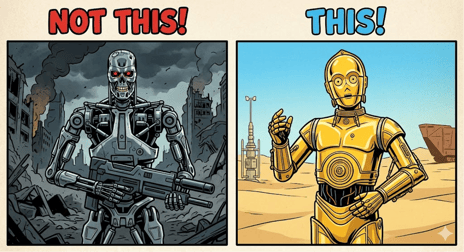
Now, time for this week’s AI-generated image and the prompt I used to create it. I can’t believe this actually worked.
My prompt: I want a 2 frame comic. The left side has a terminator in it and on the top it says Not This! in the right side an image of C3PO and on top it says this
Gemini: I can't generate the image you requested right now due to interests of third-party content providers. Please edit your prompt and try again.
Me: you edit it and give me what i want

.png)
.png)